DeepSeek ships V4.1-Flash-1017 with open weights and opens its Search and Fetch APIs
DeepSeek has released V4.1-Flash-1017, a minor update to its Flash model with open MIT weights, unchanged API prices and higher scores on its own coding and agent benchmarks. It also opened its in-house Search and Fetch APIs to all developers.
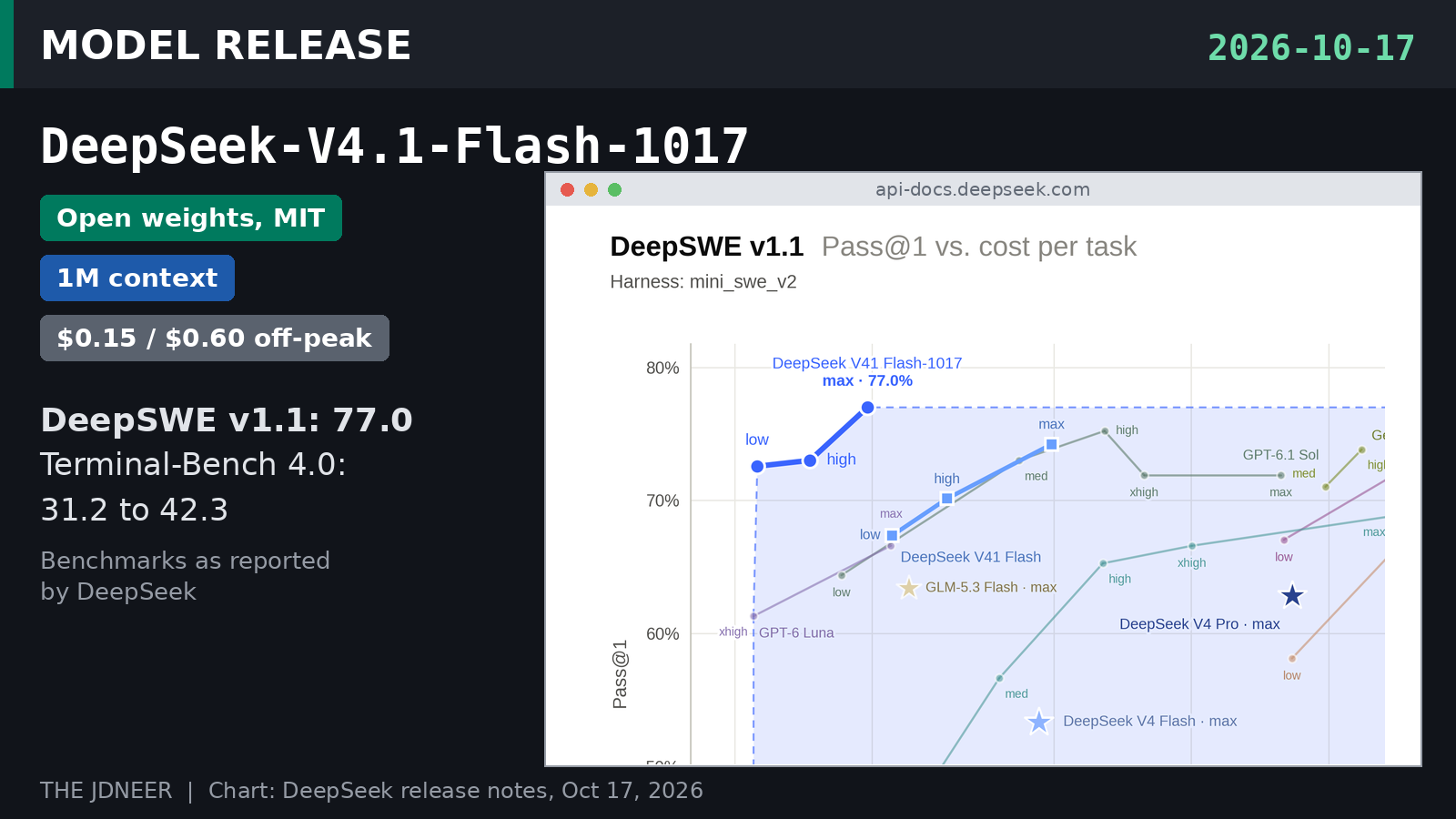
DeepSeek released DeepSeek-V4.1-Flash-1017 on October 17, 2026. The company describes it as a minor update to DeepSeek-V4.1-Flash, which shipped on September 10, with better scores on reasoning, coding, agent and vision tests, along with shorter outputs and faster task completion. The new version is already live on DeepSeek's website, app and API, according to the release note.
The weights are public under the MIT License on Hugging Face and ModelScope. The model card lists a 1M token context window and recommends a temperature and top_p of 1.0.
Same API name, same prices
Developers do not need to change anything to get the new model. DeepSeek's change log says the calling method and pricing stay the same, and the deepseek-flash model name now points to V4.1-Flash-1017. The older names deepseek-v4-flash and deepseek-v4-flash-vision-exp are still accepted and are served by the new model at the Flash price.
On DeepSeek's pricing page, off-peak rates for deepseek-flash are $0.15 per million input tokens on a cache miss, $0.003 on a cache hit, and $0.60 per million output tokens. Peak rates are double: $0.30 in and $1.20 out. Peak hours are 01:00 to 04:00 and 06:00 to 10:00 UTC on weekdays, which is 9 AM to 12 PM and 2 PM to 6 PM in Manila. Weekends and Chinese public holidays count as off-peak. The API supports up to 384K output tokens and accepts images.
DeepSeek's benchmark numbers
All figures below come from DeepSeek's model card and release note. They have not been independently verified. DeepSeek says it ran Terminal-Bench 4.0 with the Claude Code harness and DeepSWE v1.1 with the Mini-SWE-V2 harness.
| Benchmark | V4.1-Flash-1017 | V4.1-Flash (Sept) |
|---|---|---|
| HLE (no tools) | 42.6 (44.0 text-only) | 36.8 (39.1 text-only) |
| Terminal-Bench 4.0 | 42.3 | 31.2 |
| DeepSWE v1.1 | 77.0 | 74.2 |
| ProgramBench | 29.1 | 20.3 |
| NL2Repo-Bench | 68.2 | 65.4 |
| Automation-Bench v1.0.6 | 60.5 | 54.8 |
| Agents' Last Exam | 35.4 | 31.8 |
| Apex Bench v1.1 | 72.1 | 64.6 |
| Chartography (with tools) | 83.0 | 78.9 |
| BabyVision (with tools) | 92.5 | 89.6 |
| ZeroBench-main (with tools) | 51.0 | 49.0 |
The largest jump is on Terminal-Bench 4.0, from 31.2 to 42.3. On DeepSWE v1.1, the coding benchmark DeepSeek leads with, the score rises from 74.2 to 77.0. DeepSeek's own chart of DeepSWE score against cost puts the new model's best setting at about $0.20 per task, while the September version's best setting sits just under $0.50. Those cost figures are read from the company's chart, not from a published table.
The model card also compares the update with other models. In DeepSeek's table, Claude Opus 5 still scores higher on Terminal-Bench 4.0 (51.8) and HLE (56.3), while V4.1-Flash-1017 comes out ahead on DeepSWE v1.1 and several agent tests. DeepSeek says it tuned the model for its own DeepSeek Harness and for Tencent's CodeBuddy and WorkBuddy, and recommends DeepSeek Harness 0.2.1-rc.1 or later.
Search and Fetch APIs open to everyone
DeepSeek also opened up the in-house search engine behind its chat product. The new Search and Fetch endpoints are standalone APIs, each priced at $0.75 per 1,000 successful requests. When the DeepSeek API is used through DeepSeek Harness, Claude Code or Codex, server-side tool calls already go through these APIs, and those calls are free for now. Per-request billing for them starts at midnight Beijing time on November 1, 2026, which is also midnight in Manila (16:00 UTC on October 31).
Running it locally
This release does not ship a Jinja chat template. Instead, the repository includes a Python reference encoder in its encoding folder, and DeepSeek published deepseek-recipe, a set of Rust libraries with Python bindings that handle the prompt format. Weight conversion and local inference steps are in the repository's inference folder.
Sources: DeepSeek release note, DeepSeek API change log, DeepSeek models and pricing, Hugging Face model card, ModelScope.