Four Critical J-Web Flaws Let Attackers Take Over Junos Devices Without Logging In
Juniper's October release fixes four CVSS 9.8 flaws in J-Web, the Junos web interface, that let unauthenticated attackers bypass login or run code as root. There are no workarounds, so patching and locking J-Web down to trusted hosts is the answer.
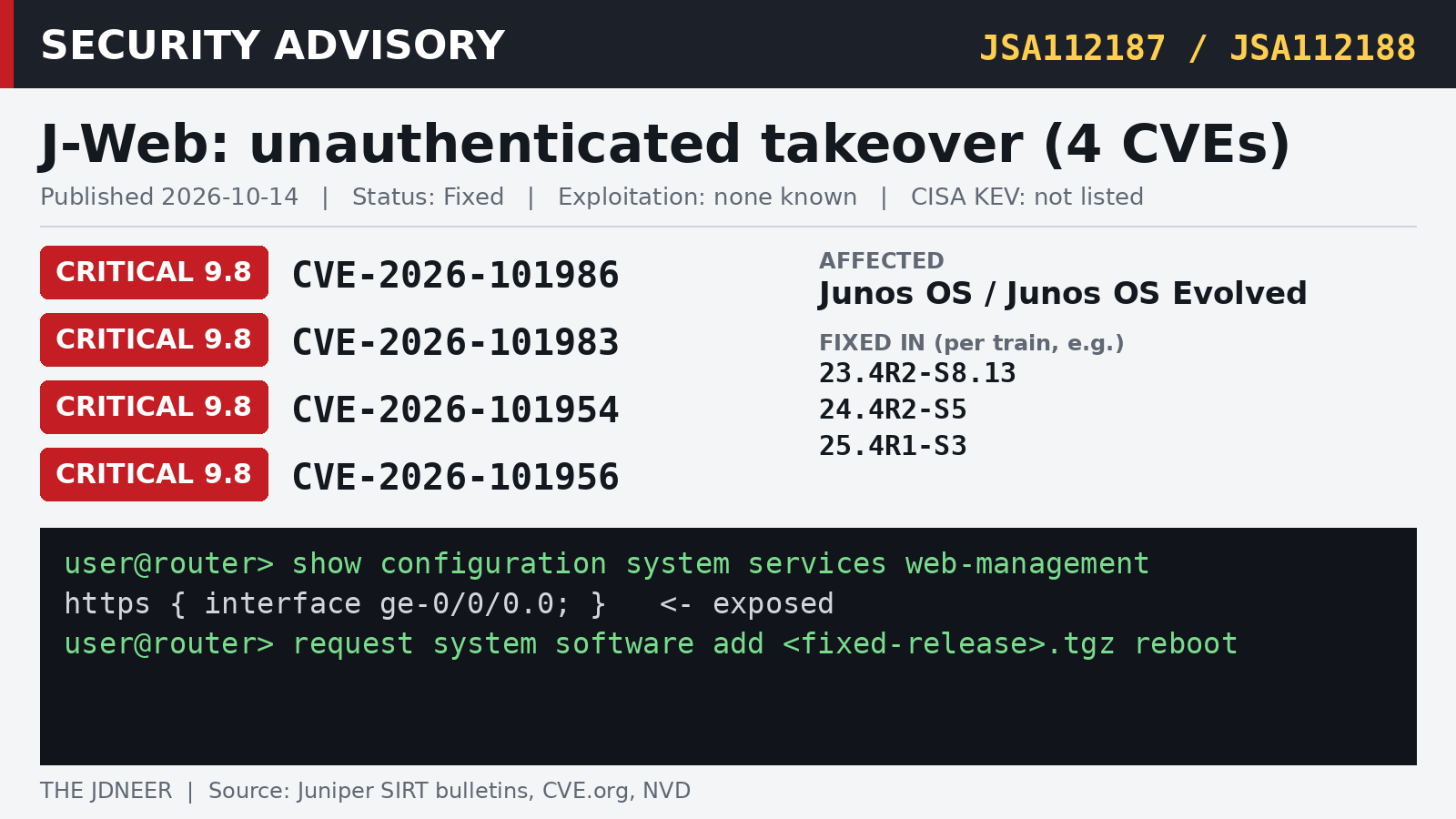
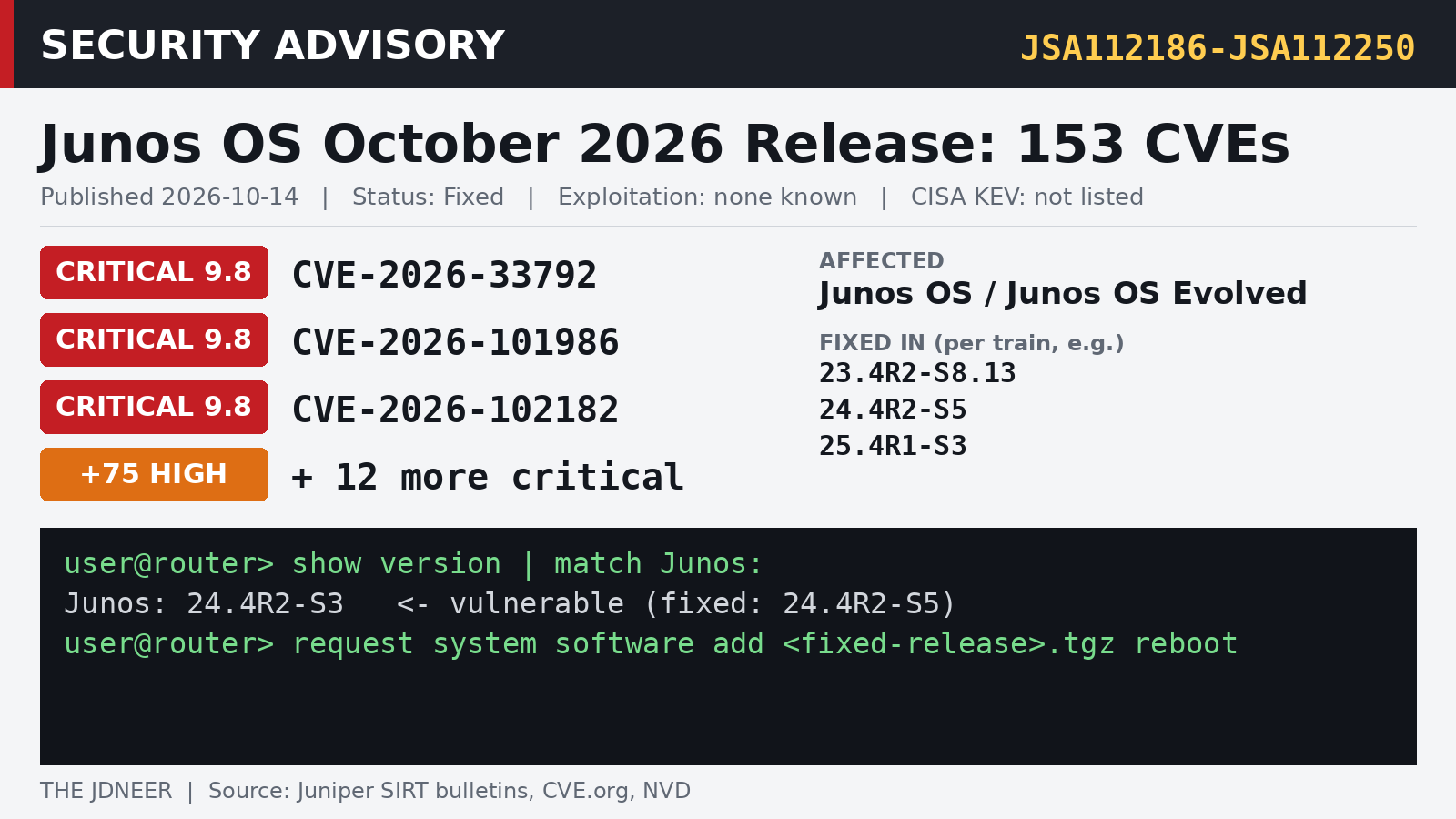
J-Web, the browser-based management interface built into Junos OS and Junos OS Evolved, accounts for four of the fifteen critical flaws in Juniper Networks' October 14 security release. Each is rated CVSS 9.8 (9.3 under CVSS 4.0) and each can be exploited by an attacker who never logs in, provided the web interface is enabled and reachable. Juniper lists no workarounds for any of them, though it says it is not aware of malicious exploitation, and none appear in CISA's Known Exploited Vulnerabilities catalog. They are covered alongside the rest of the release in THE JDNEER's overview.
The widest reach belongs to CVE-2026-101986, an authentication bypass that lets a crafted HTTP request run CGI content with elevated privileges. It affects every Junos OS and Junos OS Evolved release before the October fixes. CVE-2026-101983 is a stack-based overflow in httpd that allows remote code execution, but only when a J-Web virtual domain with mTLS is configured, on releases from 23.4 onward.
The two others affect only the newest trains, 25.2, 25.4 and 26.2. CVE-2026-101954 abuses J-Web's NETCONF session handling to give an unauthenticated attacker root-level configuration access and full control of the device. CVE-2026-101956 lets a remote attacker run arbitrary Junos commands as root through an exposed J-Web interface, on Junos OS.
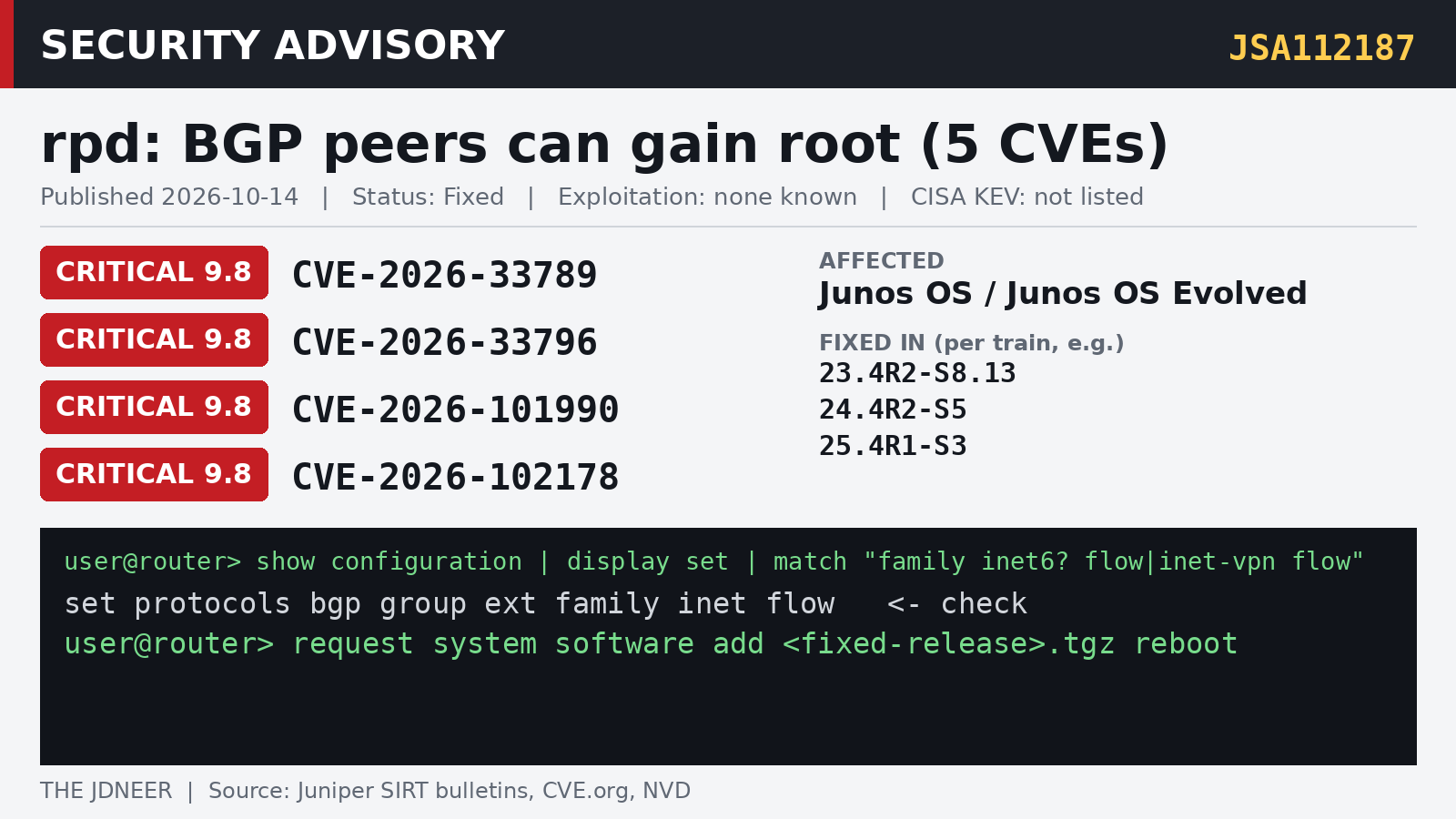
Two other critical management-plane bugs are worth checking at the same time. CVE-2026-102175 is a heap overflow in sdxd, the service-deployment daemon, that an attacker able to control or intercept the configured SDX/SRC server connection can use to run code as root. CVE-2026-102031 is an OS command injection in Junos OS Evolved's TACACS+ handling that lets a low-privileged authenticated user gain root when periodic TACACS+ authorization refresh is enabled.
Are you affected?
A quick way to check exposure, based on the conditions Juniper lists in its advisories. Run these from operational mode on each device.
- ☐ Run
show versionand compare the Junos release against the fixed builds for your train. Anything older than the fixed build in your train is affected. - ☐ Run
show configuration system services web-management. If HTTP or HTTPS is configured, J-Web is on and CVE-2026-101986 applies; on 25.2, 25.4 or 26.2, so do CVE-2026-101954 and CVE-2026-101956. - ☐ Check Juniper's JSA112187 for the J-Web virtual-domain condition. If your configuration matches it on 23.4 or later, CVE-2026-101983 applies.
- ☐ Look at which interfaces J-Web listens on and whether those are reachable from the internet or other untrusted networks. Reachable means exposed to an unauthenticated attacker.
- ☐ Run
show configuration system services service-deployment. A configured server means CVE-2026-102175 applies. - ☐ On Junos OS Evolved, run
show configuration system tacplus-options. Anauthorization-time-intervalsetting means CVE-2026-102031 applies.
Patch guidance
For Junos OS, the fixed releases are 23.2R2-S7.7, 23.4R2-S8.13, 24.2R2-S5.5, 24.4R2-S5, 25.2R2-S2, 25.4R1-S3 and 26.2R1-S2. For Junos OS Evolved, they are 23.2R2-S7.7-EVO, 23.4R2-S8.11-EVO, 24.2R2-S5.6-EVO, 24.4R2-S5-EVO, 25.2R2-S2-EVO, 25.4R1-S3-EVO and 26.2R1-S2-EVO, plus 25.2X100-D35-EVO and 25.4X300-D40-EVO.
- Find every device with
system services web-managementconfigured. If J-Web is not needed, turn it off. - Where J-Web is needed, keep it off internet-facing interfaces and limit it to trusted management hosts. That reduces exposure but does not replace the upgrade, since Juniper lists no workaround.
- Check for
system services service-deploymentand fortacplus-options authorization-time-intervalon Evolved devices, and prioritize those boxes too.
The bulletins are JSA112187, JSA112188 and, for the TACACS+ flaw, JSA112250.
Sources: Juniper Networks security bulletins on its support portal (some pages require a Juniper account), Juniper's CVE records as published to CVE.org and the NVD, and CISA's Known Exploited Vulnerabilities catalog, checked October 16, 2026.